This case study examines how Philadelphia’s urban agriculture community successfully reformed Pennsylvania’s adverse possession law to reduce the required continuous land use period from 21 to 10 years, creating a new pathway for community gardeners to secure legal title and protect long-tended gardens from development and displacement.
Key Points
- Adverse possession is a legal tool that allows people who openly use and occupy land without permission to get legal title to that land after a certain period of continuous possession and use (generally between 7 and 21 years).
- Farmers, gardeners, and community organizers called for reform to Pennsylvania’s adverse possession law to protect Philadelphia’s many gardeners using privately-held land without permission.
- In 2024, Pennsylvania enacted a law reducing the required period of continuous possession for successful adverse possession claims for Philadelphia’s community gardens from 21 years to 10 years.
- With adverse possession reform in place, dozens of Philadelphia farms and gardens are poised to permanently secure access to the land they have been tending for years.
Why Does Adverse Possession Matter for Urban Agriculture?
Adverse possession is a legal tool that allows people who openly use and occupy land without permission to get legal title to that land. In Philadelphia, gardeners successfully persuaded lawmakers to update the state’s adverse possession law and reduce the required number of years from 21 to 10, which helped gardeners secure permanent ownership of the land they cultivate. This legislative change opens a new pathway to land ownership for gardeners who have been tending to the same plots for years without formal permission. Importantly, adverse possession generally does not provide a practical pathway for newer farmers and gardeners to gain access to land because of the lengthy time requirement.
The Problem
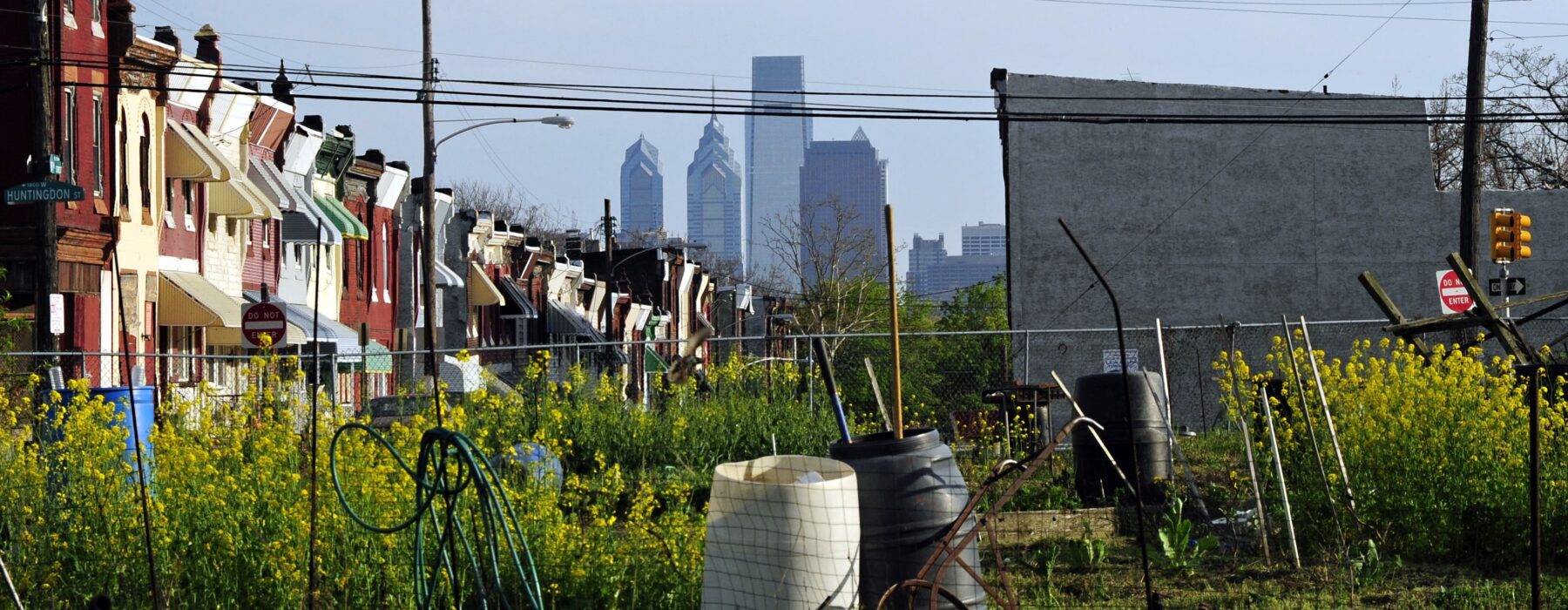
Many farmers and gardeners in Philadelphia do not have secure land tenure and grow food on vacant land where they do not have legal ownership rights, even though they may have been using the land for decades. This lack of legal ownership, or “title,” leaves these gardeners at risk of losing their gardens to property development.
In 1950, the population of Philadelphia, Pennsylvania, peaked at two million people. In the decades that followed, the city saw a steady population decline. As much of the city’s industrial job base shut down or moved out, wealthier Philadelphians moved out to the suburbs. Between 1950 and 1990, some neighborhoods in North Philadelphia lost as much as two-thirds of their population. Surveys throughout the late twentieth and early twenty-first centuries have identified tens of thousands of vacant lots throughout the city. In 2023, the city estimated 40,000 vacant properties.
Philadelphians have been using vacant lots to grow food for more than a century. The Vacant Lot Cultivation Association started its Philadelphia chapter in 1892, and the city’s first community garden was founded on land next to the former cemetery of the Mother Bethel African Methodist Episcopal Church in 1904. Urban renewal efforts in the 1960s cleared thousands of “blighted” properties, leaving many lots vacant and overgrown until gardeners started cultivating food on those lots in the 1970s and 1980s. Some of Philadelphia’s oldest community gardens, like Glenwood Green Acres, date back to this period. Importantly, many of these gardens were developed without formal permission from property owners to use the land. This is why they are often referred to as “squatter gardens.” For example, Glenwood Green Acres was founded on the site of a barrel factory that had been destroyed by fire and abandoned. Thirteen years later, the city flagged the garden for sheriff’s sale, which threatened to shut the garden down until the Neighborhood Gardens Trust stepped in with the winning bid.
What is a Sheriff’s Sale?
A sheriff’s sale is a public auction where a property is sold by the city to satisfy the property owner’s debt, which usually consists of unpaid bills and taxes. Sheriff’s sales are a key strategy in the City of Philadelphia’s blight and delinquency reduction efforts. Thousands of properties are sold through municipal sheriff’s sales each year. Sheriff’s sales have historically posed a threat to community gardens on privately-owned parcels because gardeners have few avenues for recourse once the city has decided to auction off the land. Recent updates to Philadelphia Land Bank policies have made it possible for the land bank to assert a priority bid in sheriff’s sales of parcels in use as gardens, which they can then transfer to the gardeners or a nonprofit partner.
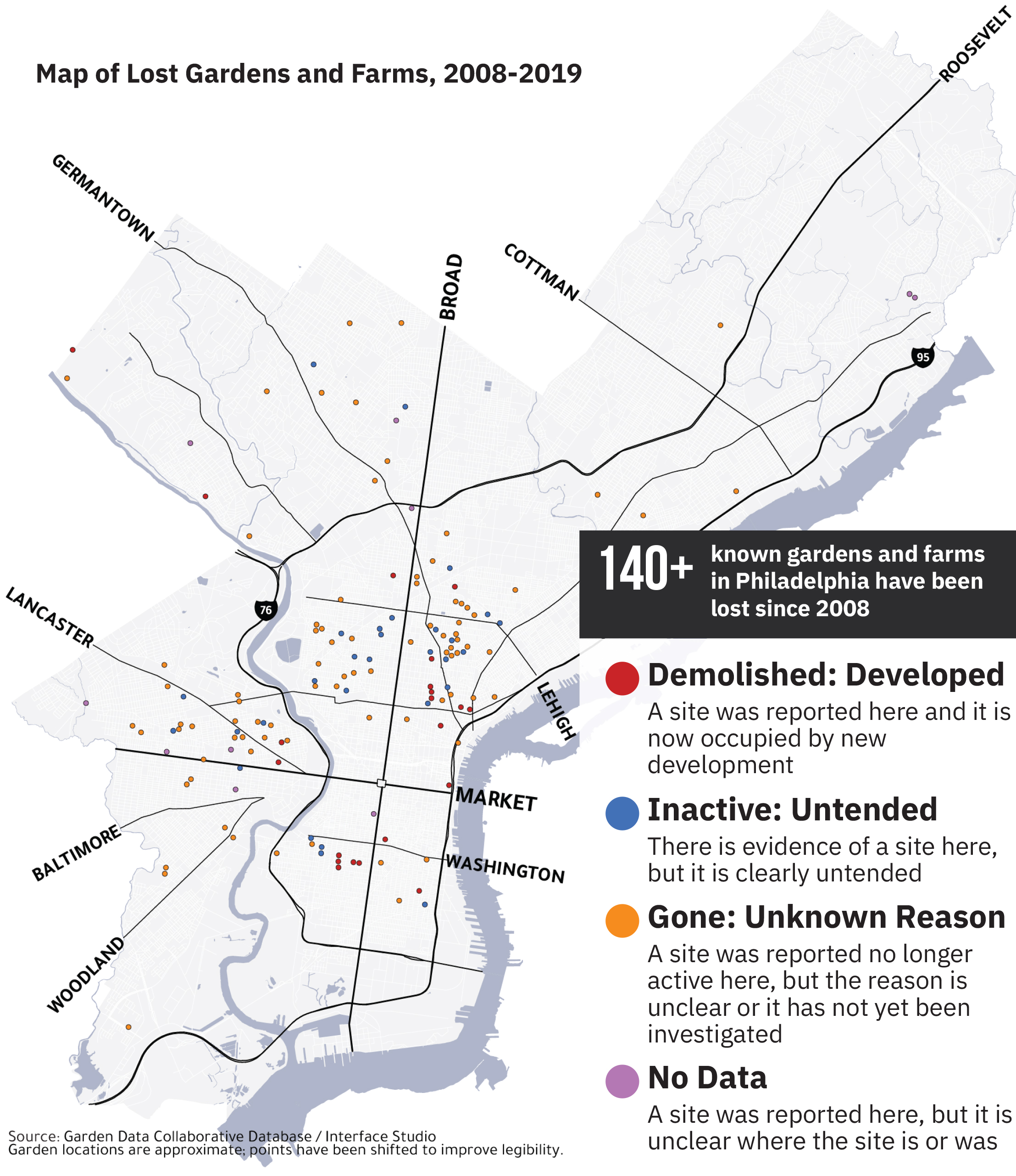
A 2009 University of Pennsylvania (UPenn) study estimated that Philadelphia’s “community and squatter gardens produced some $4.9 million worth of summer vegetables…more food than all of the city’s farmers markets and urban farms combined sold in 2008.” Studies have also shown that these gardens can help bolster mental health and reduce the risk of violent crime. There are now around 190 active community garden sites in Philadelphia—many in neighborhoods with high rates of poverty and limited access to fresh food. However, the number of gardens is declining. In 1994, a study by Pennsylvania State University Extension found 501 active gardens while the UPenn study counted 226 in 2008. Property owners often demolish community gardens to make way for development, especially in gentrifying areas.
What is Land Tenure?
Land tenure refers to a person or entity’s ability to access traditional property rights, including the right to control, access, and transfer land. When tenure is secure, a property holder is assured that these rights will be recognized by their community and the legal system, and that challenges to their property rights will be denied.
Insecure land tenure makes many Philadelphia community gardeners vulnerable to losing their land. According to Philadelphia’s urban agriculture plan, approximately 26 percent of the city’s gardens that lack land security are on privately owned land. It can be difficult to determine who owns that land; it could be an absentee landlord or heirs who are unaware that they inherited a particular parcel. Some of these lots may be tended informally by a single family or a group of neighbors. Others are affiliated with nonprofit organizations like the Neighborhood Gardens Trust and have decades-long track records of official stewardship and formal programming.
As gardeners and community garden organizations searched for solutions to protect these vulnerable and valuable gardens, they identified one major policy hurdle. Pennsylvania’s adverse possession law mandated that gardeners who did not own the land they cultivated had to prove 21 years of continuous stewardship before they could “quiet title,” or gain legal ownership of the property through a court action.
The Policy Solution
Stakeholders pushed to reform Pennsylvania’s adverse possession law to allow gardeners to legally claim ownership of their garden sites more quickly.
Once a coalition of gardeners and their supporters identified Philadelphia’s adverse possession law as a barrier, they soon developed a solution: amending the law to allow community gardeners to acquire clear title to the land after only 10 years of continuous stewardship.
Adverse possession, sometimes called “squatter’s rights,” is a legal process by which an individual can acquire the title to land by openly occupying and using it without permission for an uninterrupted number of years. State adverse possession laws generally require the land user to show “continuous, exclusive, hostile, open, and notorious” land use over a specific term of years (see “Elements of an Adverse Possession Claim” below). This
framework is intended to give the legal owner a chance to interrupt the “adverse” possessor’s claim on their property and take back the property while also rewarding the adverse possessor’s efforts to keep the land in productive use. This legal concept has been around since at least the Code of Hammurabi, nearly four thousand years ago, and is based in the legal theory that land should be kept in active, productive use.
In Pennsylvania, the number of years needed to assert legal claim over a parcel was 21 years, which is higher than many other states’ adverse possession laws (e.g., New York’s statutory term is 10 years). While drafting the adverse possession reform proposal, the policy reform coalition set a target term of 10 years for adverse possession claims for community gardens.
Elements of an Adverse Possession Claim
In most states, to establish a claim to a piece of property through adverse possession, the land user must prove through legally admissible evidence (like photos, receipts, and sworn witness testimony) that their use has been:
- Continuous (ongoing in an uninterrupted manner);
- Exclusive (no one else has been using the land at the same time, including the true owner);
- Hostile (without the permission of the landowner);
- Open and notorious (out in the open; not hidden from the true owner); and
- For a specified period of years (usually at least 7 years, depending on the state).
Note: Adverse possession can be used to gain title to privately owned land but usually not publicly owned land (e.g., city-owned land like land bank properties or public parks).
Key Features of SB 645 (Pennsylvania’s Adverse Possession Reform Bill)
- The law applies only to community gardens in “cities of the first class” (in Pennsylvania, the only city of the first class is Philadelphia);
- In addition to possessing the land for ten years, adverse possessors must have maintained it as a garden for at least five years;
- Gardens are defined as “[r]eal property that has no permanent structure that is managed and maintained by an individual, a group of individuals or a nonprofit organization, and that consists of open spaces covered with natural vegetation such as grass, plants or trees or planted vegetation such as vegetables, fruits or flowers for personal or group consumption, for donation or for sale that is incidental in nature”;
- Once land users try to claim the title by filing a court action, they must give notice to the legal owners or their heirs or other successors in ownership, who then have one year to dispute the claim of adverse possession;
- Adverse possessors must have a plan to pay off any back taxes on the parcel, unless otherwise exempt; and
- Adverse possessors who are successful in court must maintain the property as a garden for at least seven years after the title is transferred.
Community gardeners in Philadelphia make invaluable contributions to our neighborhoods by stewarding vacant lots that would otherwise sit neglected and abandoned by absentee owners or land speculators. Reducing the statutory period for ownership through adverse possession from 21 years to 10 years recognizes their significant investment and will help preserve more community gardens across our city.
— Mimi McKenzie, Legal Director, The Public Interest Law Center
The Policy Development Process
Farmers, gardeners, the Garden Justice Legal Initiative, and other community organizations pressured the city for solutions to garden loss and insecure land tenure. This coalition drafted the bill to reform the state’s adverse possession law.
The groundwork for identifying this policy solution and getting SB 645 passed through the Pennsylvania legislature was laid long before the bill hit the governor’s desk in 2024. The city’s farmers, gardeners, and allied neighbors began organizing for better city policies around food production starting in the 2000s, leading to the creation of the Food Policy Advisory Council by then-Mayor Michael Nutter in 2011. At the same time, the Philadelphia-based Public Interest Law Center launched the Garden Justice Legal Initiative (GJLI) as a legal aid and public advocacy resource for Philadelphia’s urban agriculture community. Issues related to land access were a top priority. GJLI, alongside a coalition of community organizers, pressured the city to create the Philadelphia Land Bank (an entity that holds and sells or transfers city-owned land) in 2013. Another community organization, Soil Generation, gathered more than 100 community members to testify about garden loss at a special city council meeting in 2016.
This coalition’s efforts eventually spurred the city to hire its first urban agriculture director in 2019 and draft and adopt its first urban agriculture plan in 2023, Growing from the Root. Secure land tenure for Philadelphia’s urban growers has been at the heart of many of these initiatives as the city’s land bank has struggled to provide a meaningful pathway to land for urban producers and development pressure has only increased.
In 2019, members of GJLI, Soil Generation, the Philadelphia Horticultural Society, and others began drafting an adverse possession reform bill. The group consulted with representatives from the city government and community stakeholders on the language for the bill and submitted it as SB 939 in the 2021-22 legislative session.
One key consideration for the bill’s drafters was political viability: the General Assembly in Pennsylvania was split in terms of party control with Republicans controlling the State Senate and Democrats controlling the House. Given this split, any bill would need to appeal to legislators across the political spectrum. Just a couple years prior, the Assembly had passed HB 352 reducing the adverse possession term for certain residential properties to 10 years; HB 352’s bipartisan success encouraged the drafters of the garden bill that a 10-year term for gardens had a good chance of passage as well. The drafters further limited the applicability of the bill to Philadelphia to address concerns from rural legislators about squatters taking ownership of land. Nevertheless, the bill died in the judiciary committee, a body that was perceived as unlikely to understand the benefits of community gardens and urban green spaces or prioritizing the bill’s passage.
State Senators Vincent Hughes and Nikil Saval, who represent Philadelphia districts with a high density of community gardens, reintroduced the bill in the 2023-24 session as SB 645. The bill’s supporters made a significant effort to educate judiciary committee members on its benefits, including those related to public safety, stormwater management, heat island effect mitigation, and other environmental benefits, through written testimony and the assistance of a professional lobbyist who regularly advocates on behalf of the Pennsylvania Horticultural Society. The bill worked its way through four rounds of committee consideration before it passed the House and Senate and was signed into law by the governor in July 2024.
Anticipated Policy Impact
The new law gives dozens of existing urban gardens in Philadelphia a chance to survive through property acquisition and secure land tenure. Attorneys at GJLI note that gaining title to a piece of land through an adverse possession action is a complex legal process: land seekers must find and hire a lawyer, gather legally admissible evidence that shows continuous possession for the requisite period, track down often-absentee landowners to respond to the suit, and commit time and resources to go to court. The successful adverse possessor will still be responsible for tax debt. However, a nonprofit possessor may be able to get some or all taxes waived. Despite these challenges, urban agriculture supporters in Philadelphia are optimistic that this reform provides a pathway to land security for those who have been investing in otherwise abandoned property for years.
Lessons Learned
- Community organizing and creative approaches are necessary to achieve ambitious policy change goals.
- Adverse possession reform at the state level can be a tailored solution to land access problems for urban farmers.
- Policy change often builds off other successful bills in related policy areas to have a greater chance of political success, particularly in states or political environments where bipartisanship is required.
- Consistent organizing over the long term pays off as new policy priorities require community response.
Acknowledgments
This resource was produced by the Center for Agriculture and Food Systems (CAFS) at Vermont Law and Graduate School (VLGS). It was authored by Liz Turner with editorial and production support from Laurie Beyranevand JD’03, Lindsey Connolly MELP’11, Lihlani Nelson, and Austin Price; and design by Jeff Warner of Vermont Design Collective. This resource was reviewed by project advisory group members Anita Adalja (Ashokra Farm/Not Our Farm), Andrea Clark, Nelson Hawkins (We Grow Farms/Ujamaa Farmer Collective), Christian Kanlian (The Urban Assembly School for Green Careers), Amanda Karls (Foodvocate LLC), Molly Riordan, Mina Seck (SPROUT), Molly Stanek (The Aquaponics Association), and Latha Swamy (City of New Haven); external reviewer Mimi McKenzie (Public Interest Law Center); and staff from the USDA Office of Urban Agriculture and Innovative Production, Markus Holliday and Sean Potts. The findings and perspectives expressed in this resource are solely attributable to the author.
This case study is part of a series of resources on legal topics related to urban agriculture and innovative production. It was produced with support from the Office of Urban Agriculture and Innovative Production at the U.S. Department of Agriculture. View the whole project at cafs.vermontlaw.edu/projects/urban-agriculture-and-innovative-production.
Suggested Citation
Ctr. for Agric. & Food Sys., Farming Without Permission: How Philadelphia’s Urban Agriculture Community is Securing Land through Adverse Possession (2026), https://cafs.vermontlaw.edu/resource-library/farming-without-permission.