This case study shows how New Orleans farmers, gardeners, and community organizations worked together to get the city to pass a resolution that created New Orleans’s first urban agriculture liaison position. It illustrates the significance of a dedicated point of contact within city government that can both provide technical assistance to farmers and keep urban agriculture a government priority through programming and policy development.
Key Points
- Prior to 2024, New Orleans farmers and gardeners did not have the capacity or support to navigate complex local regulations and time-consuming municipal processes.
- The New Orleans urban agriculture community banded together to improve the local policy environment, which included identifying a need for a dedicated point of contact to help navigate city government.
- In October 2024, New Orleans hired an urban agriculture liaison within the Office of Resilience and Sustainability (now housed under the City Planning Commission).
- Today, the urban agriculture liaison supports farmers with technical assistance, policy development, and community engagement.
How Can Designated City Personnel Support Urban Agriculture?
As urban agriculture becomes increasingly popular in cities across the United States, local governments have dedicated more financial resources and city personnel to support urban food production. Of the 17 cities originally designated by the USDA as “urban agriculture hubs,” nine cities employ an urban agriculture director or comparable urban agriculture point person within city government, such as New Orleans’s urban agriculture liaison. An additional two cities have an urban agriculture advisory council or staff dedicated to supporting some form of urban agriculture from within a city department.
While the precise role of an urban agriculture point person within city government varies from city to city, in all cases, they serve as a connection point between the local community of urban farmers and gardeners and city government. Urban agriculture staff generally help develop urban agriculture policies; convene stakeholders to gather community input on city policies and processes; and provide technical guidance to producers on how to navigate city processes, such as permitting or enforcement proceedings. In cities without an urban agriculture point person, farmers and gardeners may not know who to contact when confronting an individual challenge while dealing with the city, or when attempting to change an outdated policy.
The Problem
Despite having deep roots in the city, without a clear point of contact within city government, New Orleans’s urban farmers and gardeners, felt that their concerns were largely unheard and unaddressed by city government.
The City of New Orleans has a rich history of backyard and community orchards and gardens that dates to the late nineteenth century. This “vibrant and connected community of farmers and gardeners” persists today, but in the 2010s, producers in New Orleans were having trouble getting their concerns and interests addressed by local government. A common reason for this difficulty is that farmers do not have the time to seek government support or navigate complex bureaucratic processes. The practice of farming is incredibly time-consuming; farmers prioritize growing food and managing their farms over completing the many procedural steps necessary to receive a permit for a new hoophouse, resolve a blight citation, or propose a zoning update.
In 2022, a coalition of urban farmers and nonprofit organizations called A Greener New Orleans (AGNO) wrote, “farmers and gardeners struggle to get the help they need when it comes to interacting with city government and departments. In turn, city departments often do not have policies and procedures in place that would allow staff members to quickly and clearly provide support and answers to growers.” In New Orleans, urban farmers and community gardeners found it nearly impossible to locate basic information about the city’s urban agriculture policies and did not know who to contact within city government to address agricultural concerns. As a result, they often received unnecessary code enforcement tickets, overpaid for city services like water, and struggled to access any of the city’s large holdings of vacant land.
“Farmers and gardeners struggle to get the help they need when it comes to interacting with city government and departments. In turn, city departments often do not have policies and procedures in place that would allow staff members to quickly and clearly provide support and answers to growers.”
— A Greener New Orleans
The Policy Solution
Farmers, gardeners, and nonprofit organizations formed a coalition to encourage the city to create an urban agriculture liaison position, housed within the city’s Office of Resilience and Sustainability.
In 2022, urban farmers and nonprofit organizations launched A Greener New Orleans (AGNO), an initiative to address the communication barriers between urban producers and local government officials. Among the many challenges the urban agriculture community faced, AGNO identified the need for an urban agriculture liaison within city government with two primary responsibilities: (1) field questions from farmers, create policy recommendations, and attend meetings with city officials (such as blight hearings); and (2) serve as a point of contact on urban agriculture issues for both growers and the city. AGNO’s efforts culminated in the successful passage of Resolution R-23-244 in May 2023 and the first urban agriculture liaison was hired the following year.
The Policy Development Process
For decades, community members and urban producers worked together to make the City of New Orleans hospitable to urban agriculture and community gardening. A Greener New Orleans coordinated these efforts.
In 2005, the devastation from Hurricane Katrina strained New Orleans’s food system. Five years after the storm, the city had half its original number of retail grocery stores. Due to the lack of support from the government and private sector, New Orleanians took matters into their own hands by developing new urban farms and gardens that could fill gaps in fresh food distribution throughout the city. However, these farms and gardens faced challenges navigating city policies. Community members who organized these farms and gardens began meeting to discuss common complaints, particularly with the city’s zoning code.
Meanwhile, in 2015, the City of New Orleans published “Resilient New Orleans: Strategic actions to shape our future city,” a strategic plan to prepare the city for environmental change like extreme storms and sea level rise. With the plan’s publication, the city created its Office of Resilience and Sustainability (ORS). A few years later, the urban agriculture community in New Orleans successfully worked with similar groups around the country for the inclusion of urban agriculture in the 2018 farm bill, which helped maintain community connections and conversations about urban agriculture in the city.
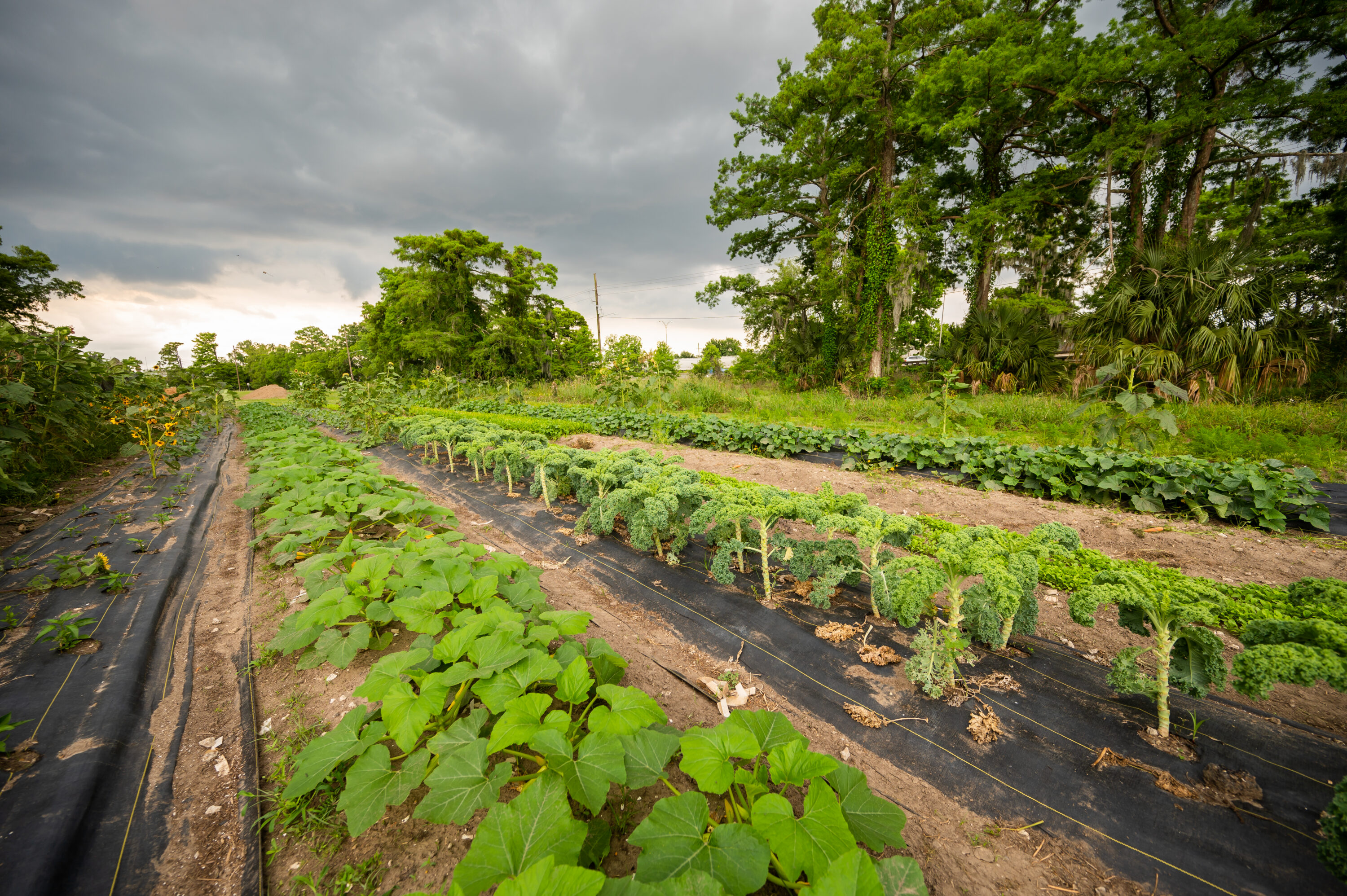
When the COVID-19 pandemic struck in 2020, hundreds of stakeholders, led by representatives from SPROUT NOLA (now just called “Sprout”), Greater New Orleans Growers Association (GNOGA), and the New Orleans Food Policy Advisory Committee (now the New Orleans Food Policy Council, and referred to from here on as NOFPC) convened with the goal of persuading ORS to meet its mandate to support a strong local economy and develop neighborhood infrastructure adapted to New Orleans’s unique vulnerabilities to hurricanes and other extreme weather events. Inspired by cities like Boston, Detroit, and Washington, D.C., all of which had successfully positioned urban agriculture personnel in city government, the group created A Greener New Orleans (AGNO). One primary goal was an urban agriculture liaison who could coordinate between city officials and urban growers. The AGNO priorities were informed by a community survey distributed to growers in the city in 2021. After the survey, AGNO conducted follow-up interviews with survey participants, convened broader community meetings on urban agriculture issues, and solicited broad public participation through incentives like free childcare and monetary stipends. Once the AGNO platform was up and running in 2022, coalition members conducted a number of outreach activities, including: (1) meeting with every available city councilmember and office; (2) hosting multiple public engagement events, including farm tours; (3) sending dozens of postcards to city councilmembers; and (4) neighborhood door to door visits that resulted in the collection of over 550 signatures to support AGNO. Resolution R-23-244 was supported by public comments from 17 speakers who shared their perspective on the value of an urban agriculture liaison. These comments expressed the value of local food production for personal health and community vibrancy as well as the economic benefits of urban agriculture, such as increased job opportunities and greater use of public space.
Once the city council passed the resolution, the AGNO coalition began meeting with city officials to move forward with their priorities. While members of AGNO initially expected to gain the most traction with the recommended reforms to the city’s water access and zoning policies, the urban agriculture liaison position was the first plank to be completed. AGNO found a sympathetic ear in Greg Nichols, the deputy chief of ORS, who was able to work with the mayor to create the position by the fall of 2024. In creating the position, ORS signed a community accountability agreement with Sprout and NOFPC. Under this non-binding agreement, the city promised to continue to collaborate with the community in all urban agriculture matters overseen by ORS and the urban agriculture liaison. In October 2024, Grace Treffinger was hired as the city’s first urban agriculture liaison. In January 2026, ORS was reorganized by a new mayoral administration and the urban agriculture liaison position moved to the office of the City Planning Commission.
The Policy Impact
With the urban agriculture liaison in place since 2024, the City of New Orleans has moved forward with several long-awaited reforms and process improvements, with more on the horizon.
As urban agriculture liaison for the City of New Orleans, Grace Treffinger has served as an invaluable resource for urban producers and members of city government. Treffinger’s work includes: (1) creating and supporting municipal legislation; (2) providing technical assistance to farmers and government employees; (3) publishing educational materials and spearheading awareness campaigns; (4) engaging with farmers; and (5) expanding the city’s agriculture programs.
Creating and Supporting Municipal Legislation
In her role as urban agriculture liaison, Treffinger drafted an ordinance to include cover crops in the exemptions to the city’s ten-inch weed rule, which was passed by city council in September 2025. As of April 2026, she is also working on an ordinance that would allow urban producers to acquire adjudicated lots (those taken into the government‘s possession through a legal process) at low cost; and zoning amendments that balance urban livestock promotion with appropriate safeguards. In addition to conceptualizing and drafting ordinances, the urban agriculture liaison can support the passage of legislation by providing public comment to the New Orleans city council, planning commission, zoning authority, and other bodies of local government.
Providing Technical Assistance
The urban agriculture liaison position was created as a city-based intermediary between farmers and local government agencies like the Department of Code Enforcement, the New Orleans Regional Planning Commission, and the Sewerage and Water Board of New Orleans. To fulfill this responsibility, Treffinger has created guides for growers on accessing agricultural water meters, navigating greenhouse permitting, and understanding animal husbandry rules; provided technical assistance to individual growers on water access; helped resolve individual billing issues, such as incorrect charges for sewage and trash pickup; and conducted training for code enforcement officers on plant identification to reduce unnecessary violations. Treffinger also maintains an “Urban Agriculture Support Request” form on the city’s website which allows growers to request assistance resolving any issues with city agencies or processes.
Sharing Educational Materials and Campaigns
The urban agriculture liaison is tasked with providing information to the public about urban agriculture—such as educational yard signs that explain native plants to reframe neighbors’ perceptions and preempt their complaints—and to interpret city processes to farmers and gardeners, such as a guide for accessing water for irrigation. The urban agriculture liaison also drafts materials to inform the city about urban agriculture. For example, Treffinger drafted and submitted agriculture-related feedback for the city’s Land Use Barrier Study.
Engaging with Farmers and Gardeners
A key facet of the urban agriculture liaison’s role is to engage with farmers and solicit feedback to deliver to decision-makers in city hall. This manifests most notably through the Urban Agriculture Working Group (UAWG), which was created as a way for producers across New Orleans to share their concerns and influence how the city adopts new or changes existing policies and programs to better support urban food production. This working group enables the urban agriculture liaison to better understand the interests of farmers, which then shapes potential legislation, policies, and programs. The urban agriculture liaison also engages with individual growers through the support request form described above.
Keeping Urban Agriculture a City Priority
In addition to the substantive work described above, dedicated urban agriculture personnel can contribute to improving urban agriculture by generally uplifting its value to city officials. In New Orleans, the urban agriculture liaison acts as a permanent foothold for urban agriculture in city government and helps maintain urban agriculture as a priority for city policymakers. To this end, Treffinger is currently working toward a comprehensive Urban Agriculture and Food Plan for the city in collaboration with Sprout and NOFPC.
Lessons Learned
- Urban agriculture liaisons or similar dedicated urban agriculture personnel can help resolve administrative issues, such as blight citations or overbilling for water, that burden farmers so that farmers can focus on the hard work of running a farm.
- A well-placed point of contact for farmers within city government can help urban agriculture communities make meaningful policy change that resolves previously intractable producer concerns.
- Building connections with city council members is critical for producers’ needs to be considered in city policymaking.
- Legislative change to support urban agriculture requires committed, long-term efforts from the community.
- Implementing an urban agriculture liaison, director, or similar “point person” position in city government can be an effective strategy to make cities more hospitable to food production.
Acknowledgments
This resource was produced by the Center for Agriculture and Food Systems (CAFS) at Vermont Law and Graduate School (VLGS). It was authored by Seth Isreal and Liz Turner, with editorial and production support from Laurie Beyranevand JD’03, Lindsey Connolly MELP’11, Lihlani Nelson, and Austin Price; and designed by Jeff Wainer of Vermont Design Collective. This resource was reviewed by project advisory group members Anita Adalja (Ashokra Farm/Not Our Farm), Andrea Clark, Nelson Hawkins (We Grow Farms/Ujamaa Farmer Collective), Christian Kanlian (The Urban Assembly School for Green Careers), Amanda Karls (Foodvocate LLC), Mina Seck (SPROUT), Molly Stanek (The Aquaponics Association), and Latha Swamy (City of New Haven); and Markus Holliday from the USDA Office of Urban Agriculture and Innovative Production. The findings and perspectives expressed in this resource are solely attributable to the authors.
This case study is part of a series of resources on legal topics related to urban agriculture and innovative production. It was produced with support from the Office of Urban Agriculture and Innovative Production at the U.S. Department of Agriculture. View the whole project at cafs.vermontlaw.edu/projects/urban-agriculture-and-innovative-production.
Suggested Citation
Ctr. for Agric. & Food Sys., Connecting Growers with City Government: How New Orleans’s Urban Agriculture Liaison Supports Farmers and Helps the City Prioritize Urban Food Production (2026), https://cafs.vermontlaw.edu/resource-library/connecting-growers-with-city-government.