Catch share programs are a common fishery management strategy in which an annual catch limit is divided into shares to allocate to individual fishermen or entities. This report discusses some of the challenges of these programs and their potential impacts on coastal communities.
Introduction
Marine fisheries in the United States span 4.4 million square miles, surpassing the nation’s entire land mass. This vast area is managed by the federal government and affects the health of our oceans, the livelihoods of coastal communities, the integrity of our food system, and the future of a public resource that should be managed for the benefit of the public.
Catch share programs are a fishery management approach implemented in many U.S. fisheries. The Magnuson-Stevens Fishery Conservation and Management Act (MSA), passed in 1976, is the principal law governing marine fisheries in the United States. The Act established eight regional fishery management councils, set forth ten national standards for fishery management, and authorized the Secretary of Commerce to review and implement fishery management plans. Since the early 1990s, the Regional Fishery Management Councils have created 17 catch share programs in commercial fisheries.
Catch share programs allocate portions (called quotas) of a fishery’s total allowable catch (TAC) to individual entities, giving them exclusive rights to their allocation. Essentially, these programs divide a public resource into shares that can often be bought, sold, and leased. Proponents of catch shares view this privatization of fisheries as a market-based solution that can prevent the depletion of a shared resource that might result from competing individual interests. By privatizing public resources, proponents claim, shareholders will be incentivized to protect them. Many social and political scientists have challenged this concept, noting that communities have successfully stewarded shared natural resources.
Catch share programs were initially touted as successful among conservation and environmental groups. However, evidence of significant ecological benefits remains limited. One study indicates that catch share implementation has reduced bycatch discards (catch of non-target species that are thrown away) by an average of 31 percent within the first five years and up to 66 percent over ten years. Yet, other ecological indicators such as population biomass have shown little change. Additionally, some argue that catch share programs have driven consolidation in fisheries, pushing out communities that have depended on these fisheries for generations.
This report addresses key challenges associated with catch share programs as currently implemented in the U.S.; namely, these programs:
- Often fail to meet one or more of the national standards for fisheries established in the MSA;
- Reduce social and economic benefits for fishing communities and small-scale fishermen due to initial allocations and consolidation of shares over time;
- Are often treated as creating private property rights despite the MSA explicitly precluding this interpretation; and
- Do not operate transparently, which undermines congressional oversight.
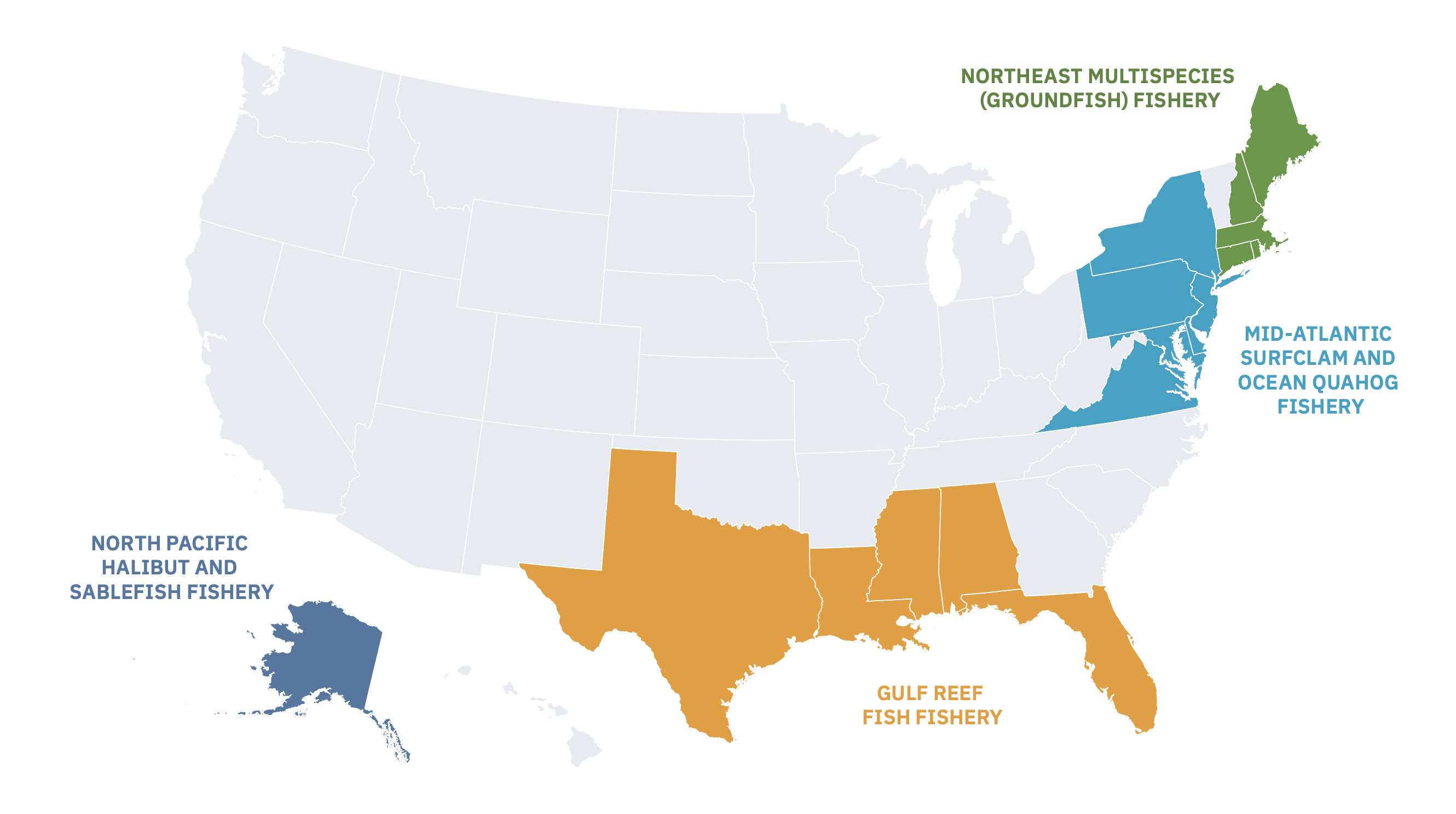
To illustrate these challenges, this report includes profiles of catch share programs from four fisheries: Mid-Atlantic Surfclam and Ocean Quahog, Gulf of Mexico Reef Fish, Northeast Multispecies (Groundfish), and North Pacific Halibut and Sablefish.
Each fishery has distinctive catch share design features, yet they face similar challenges. The Northeast Groundfish program operates through sectors, which are self-governing groups of permit holders. While many fisheries have experienced consolidation, the Mid-Atlantic Surfclam and Ocean Quahog program stands out for its significant decrease in participating fishermen over time. The Gulf of Mexico Reef Fish program has a reported history of intimidation of fishermen who publicly criticize the catch share program. Among the four fisheries discussed in this report, the North Pacific Halibut and Sablefish program best supports the sustained participation of fishing communities but offers opportunities to better meet national fishery standards.
Acknowledgments
This report was produced by the Center for Agriculture and Food Systems at Vermont Law and Graduate School. The lead authors of this report are Emily Spiegel, Director of Research and Senior Research Fellow; Lindsey Connolly, Program Manager and Research Fellow; Wendy Chen, former Staff Attorney; with Summer Honors Intern Johanna Silva and Food and Agriculture Clinician Andrew Hockenberry.
This report was written in consultation with the North American Marine Alliance.
We thank the following people for reviewing and providing feedback on this report: George Kimbrell, Center for Food Safety; James Mitchell, North American Marine Alliance; Ann Robertson, AKWA-DC; Ryan Bradley, Catch Shares Reform Coalition; Josh Eagle, University of South Carolina School of Law; Courtney Carothers, University of Alaska Fairbanks, College of Fisheries and Ocean Sciences.
We also thank to the following individuals within the fishing industry for speaking to us about their work: Ryan Bradley, commercial fisherman; Alexus Kwachka, commercial fisherman; Ron Chicola, commercial fisherman; Tim Barrett, commercial fisherman, and those who wished to remain anonymous. Their generosity with their time and expertise greatly increased our understanding of the practices and dynamics at issue in this report. The reviewers and interviewees did not review the final document and do not necessarily agree with the report’s full content but provided enormously thoughtful guidance and feedback on its content.
Thank you to the following Vermont Law and Graduate School students who supported the research process: Nicole Renna, Josephine Pechous, and Travis Rosenbluth. Finally, this report would not have been possible without the tremendous editing, production, and communications support of the Center for Agriculture and Food Systems, including Laurie Beyranevand, Director; Lihlani Nelson, Deputy Director and Senior Researcher; and Austin Price, Communications Manager. This resource was designed by Hoan Marketing, with original artwork for each fishery profile by Lindsey Connolly.
Suggested Citation
Ctr. for Agric. & Food Sys., Fair Shares? An Analysis of Catch Share Programs in the U.S. (2026), https://cafs.vermontlaw.edu/resource-library/fair-shares.